
IN THE NEWS
Inside The Emerging Microcollege Movement
By Kerry McDonald,Forbes Contributor.

For Layla Coyne, choosing to attend a microcollege was a natural extension of her unconventional K-12 schooling experience. As a middle schooler, she left a traditional public school to attend Rock Tree Sky, a self-directed learning community in Southern California that offers part-time programming for local homeschoolers and charter school students. For high school, she continued at Rock Tree Sky while enrolling at Summit School, a public independent study program offered through the Ojai Unified School District. She also took dual enrollment courses through a community college and spent nearly a year studying in Paraguay.
After graduation, Coyne continued taking community college courses while pondering her next steps. It was then that she discovered Thoreau College, a microcollege in rural Wisconsin, that offers summer and semester-long programs blending homesteading and agricultural skills with academic inquiry. After attending the month-long summer program, she knew she wanted to return for the full semester experience. “I just loved every part of it,” said Coyne, who was one of five students in the fall 2024 semester cohort.
Thoreau College is one of several microcolleges that have opened in recent years, offering intentionally small, immersive programming and expanding the landscape of higher education possibilities. As the higher education sector struggles with declining public confidence, enrollment challenges and institutional closures, microcolleges emerge as a creative, collaborative model for post-secondary education.
At the microcollege, Coyne and her peers learned skills such as sheep-shearing, foraging and fire-making, while also reading and discussing the works of Wendell Berry, Henry David Thoreau, Robin Wall Kimmerer and other nature-focused authors. “I think the intention of having a small community-based school is something that is very much desired at this moment when a lot of the world is getting more and more isolated,” she said.
Average tuition for Thoreau College’s semester-long program is about $8,500, with additional fees if students wish to obtain college credit through a new partnership between Thoreau and Prescott College, a private, experiential college in Arizona.


At Thoreau College, students raise chickens, go camping and limit use of tech
VIROQUA, Wis. (WXOW) – In Viroqua, students at Thoreau College are learning in greenhouses, on farms and in small group settings as part of a program designed to combine academics with hands-on experience.
Thoreau College, described as Wisconsin’s first micro-college, offers small programs where students can earn transferable college credit while exploring a mix of hands-on and academic subjects.
“We also do five-week summer programs and year-long internships and fellowships for young adults,” Thoreau College Executive Director Jacob Hundt said. “Our mission is to really model a new form of higher education, education for adults. An education that combines academics, place-based learning in the form of agriculture, wilderness explorations, self-governing community, as well as arts and crafts.”
According to Hundt, the college began about 11 years ago and started offering prototype programs in 2016.
It has been running semester programs since fall 2019 and now attracts students from across the country and around the world to the Driftless Region.
Much of the learning happens outside, tied to the seasons and daily work on the land.
For students, the experience can serve several purposes at once: earning credits, building practical skills and helping them sort out what they want to do next.
Oliver Woodford, a 17-year-old student at Thoreau College, said he came to the school after realizing he had enough credits to finish high school early.
Woodford said he plans to attend UW-Milwaukee in the fall, though he does not yet know what he wants to study.
He said the program is giving him space to explore different paths before his next step.
“I guess the idea is that like expose myself to the widest range of things to,” Woodford said. “I guess, weed out what I do and don’t want to do and go from there.”
Woodford said students recently completed an intentional communities unit, where they visited different modern intentional communities—mostly in Wisconsin—to see how they function and govern themselves.
They also spend time in the greenhouse and out at the farm doing work like grape pruning and other seasonal tasks.
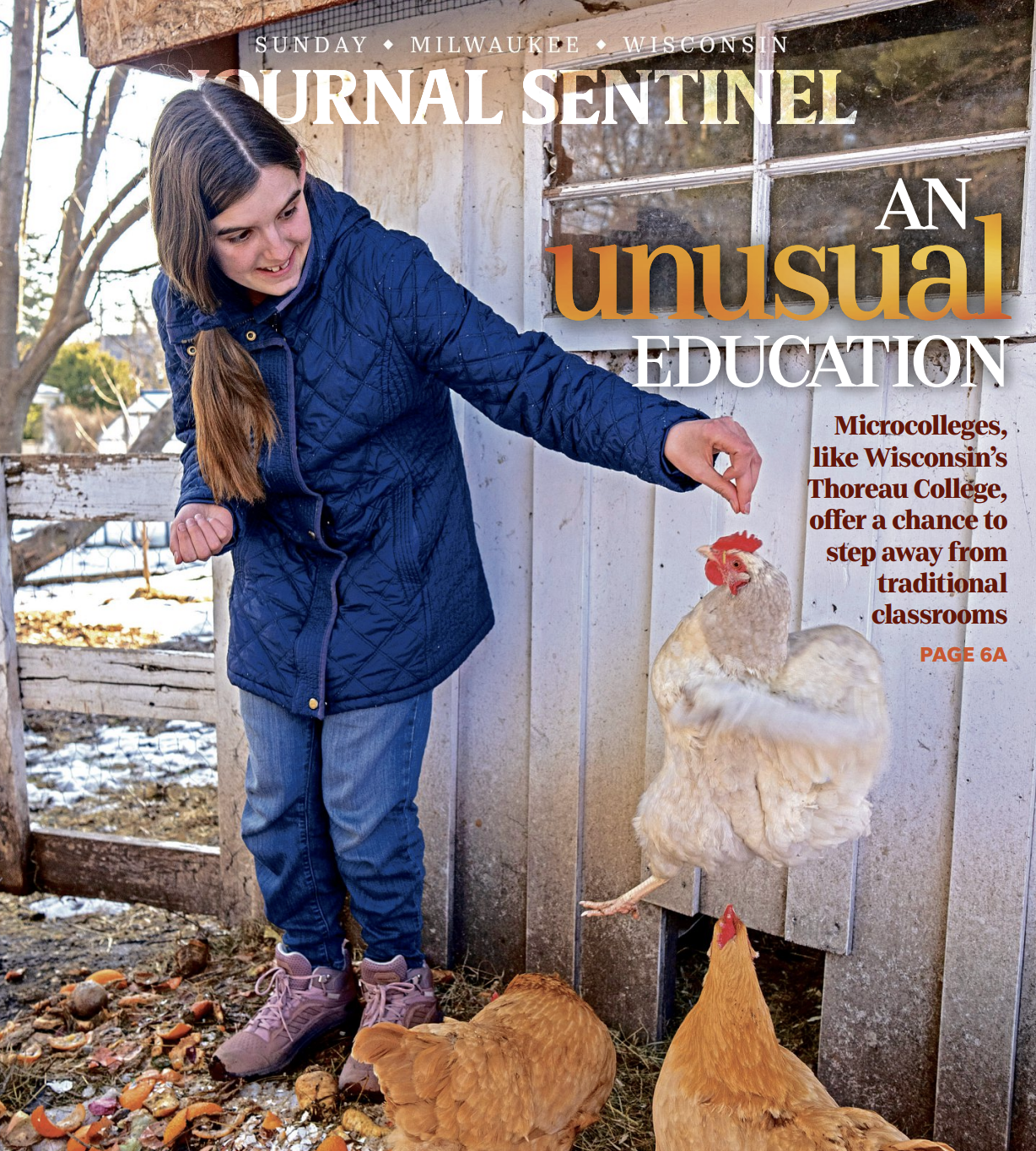
by Kelly Meyerhofer
Milwaukee Journal Sentinel
VIROQUA — It was a moonless night, perfect for stargazing. They moved some of their tents to a clearing in the woods for a better view.
Waiting for darkness to settle over the Kickapoo Valley, they paid attention to their surroundings. The earthy smell of mud caking their boots. The lingering crackle of their campfire. The owls’ hoots and coyotes’ howls echoing into the night. Students are taught to notice nature at Thoreau College, a small experimental school in western Wisconsin that operates very much offline. Assigned readings are in the form of books or paper handouts. Phones are banned during classes, meals, meetings and field trips.
The first field trip of the spring semester, five days of camping, came in mid-February. The temperature hovered above freezing during the days and dipped into the teens at night.
The students’ week was filled with a full spectrum of emotions: Impatience, because cooking meals over fire took longer than in a kitchen. Satisfaction, because food hits differently when hungry and cold. Curiosity, when they found a dead racoon on the side of the road and skinned him in a lesson blending anatomy and ethics. Joy, when they laughed around the campfire over silly stories, like one about a chihuahua named Carlos.
The students were out in the elements, far from likes, follows, reshares and comments. Nature replaced the never-ending news cycle. Smartphone-addled attention spans swapped with 60-minute “solo sits” in the woods.
Student Soren Powers, of Minnesota, said social media taxed his mental health while attending Reed College in Portland, Oregon, last fall. He is taking a gap semester this spring at Thoreau, hoping it will help him decide whether he wants to switch from a science major to something in the humanities. His average phone screen time has dropped from up to five hours per day to about 30 minutes. “I’ve been going through life on autopilot, relying on external measures of sucess, but I haven’t figured out what I actually want to do,” he said. “Thoreau is a place to slow down and see what calls to you in life.”
Microcolleges offer an alternative experience for postsecondary education
Thoreau College is tiny – just eight students this semester – and self-governing. At the heart of the school’s programming is experiential learning that bears little resemblance to the lecture halls and dorms dominating traditional higher education.
There are no provosts or associate vice provosts or assistants to the senior vice provost. There is no tenure system. No letter grades. No alcohol or drugs allowed.


Nestled in the Driftless Area, Thoreau teaches students to engage with the seasons and soils of the land. They canoe along the Wisconsin River in late summer, learn butchery in the fall, tap maple trees in early spring, grow vegetables in the summer and tend to livestock year-round. They perform about 10 hours of weekly manual labor and read works by authors ranging from Aristotle to Aldo Leopold to Wendell Berry. In a nod to the college’s namesake, students also spend several days alone in the woods.
Thoreau College is among several “microcolleges” across the U.S. that offer an experimental alternative for students disillusioned by their mainstream postsecondary options. Jacob Hundt, Thoreau’s founder, defines a microcollege as “humanly-scaled,” with a student body numbering in the single or double digits. It is intentional, creating a community that lives, learns and works together. And it has a strong sense of place, with a curriculum tied to its geographic location and history.
While some microcolleges award associate degrees, Thoreau does not, at least for now. Students can, however, earn college credits through a partnership with Prescott College in Arizona. Most microcolleges have opened within the past 15 years. Thoreau launched semester-long programs in fall 2019. The timing was apt. COVID-19 hit the following semester, a death knell for some small colleges that were already struggling financially. Wisconsin alone has seen eight public two-year campuses shutter or downsize, and three private colleges close since 2020. But for Thoreau, it marked an opening. “These small-scale, intimate environments are getting harder to find in higher education,” Hundt said.
DOWNLOAD PDF ARTICLE: What to know about Thoreau College in Wisconsin and microcolleges
Thoreau College – TeenLife LIVE Pathways After High School Virtual Fair November 2025
Discover new routes beyond graduation at TeenLife LIVE: Pathways After High School Virtual Fair: a single-evening online fair featuring speakers who spotlight gap years, career-focused programs, service opportunities, and other alternatives to the traditional four-year college trac
Colleges Need an Experiential Learning Revolution

by Eric Schwarz – https://commonwealthbeacon.org/
November 1, 2025
AMERICA IS FALLING out of love with college, and it’s not hard to see why. First, colleges are not doing enough to build purpose, confidence, agency, and maturity. Colleges are not the cause of growing anxiety and a declining sense of purpose among young people; but, faced with the reality of these trends, colleges have not changed their models nearly enough to help students build purpose, confidence, agency, and maturity.
https://commonwealthbeacon.org/opinion/colleges-need-an-experiential-learning-revolution/
Heart & Soil magazine

Fresh Learning Model
Thoreau College
Let’s raise a generation that’s grounded.
www.heartandsoilmagazine.com/
LILIPOH- the spirit in life

Thoreau College and the Microcollege Movement: An Educational Model for the Future?
-JACOB HUNDT
When the history of American higher education in the twenty-first century comes to be written, 2024 will stand out as a watershed year when many dire predictions finally came true.

Show More
Thoreau college is mentioned in this Washington Post article as part of the micro-college movement, a movement in response to the impersonal nature of large universities. Below is the part of the article that Thoreau College was mentioned in.
“Flagstaff College in Arizona, for example, also has only one major, sustainability and social change, and operates out of space on a community college campus. Other micro-colleges in various stages of development include Outer Coast in Sitka, Alaska, housed on the campus of a conventional college that closed in 2007, and Thoreau College in Viroqua, Wis. Those schools also have smaller staffs and lower overheads, with administrators often taking on several roles.
These kinds of places are “for folks who for whatever reason, and there are a lot of them, wouldn’t thrive in the traditional college model but still want college,” said Jones, Wayfinding Academy co-founder.
“Everybody agrees that our higher education system is broken,” she said. “They might disagree about what needs fixing first. But everyone is aware of the brokenness.”
Jacob Hundt - Community, Common Values, & Education
LILIPOH- the spirit in life
“Some are focusing on market needs, others on students who have long been overlooked”

Washington Post: "As enrollment falls and colleges close, a surprising number of new ones are opening" Mentions Thoreau College
“Some are focusing on market needs, others on students who have long been overlooked”
